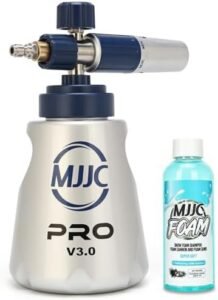
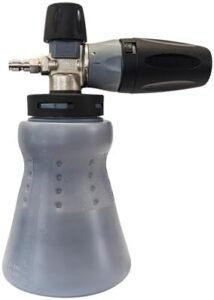
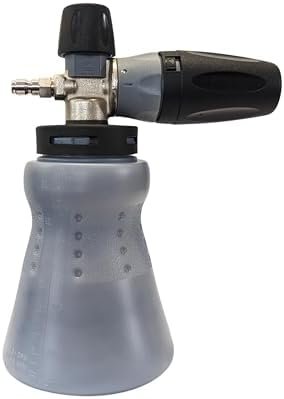
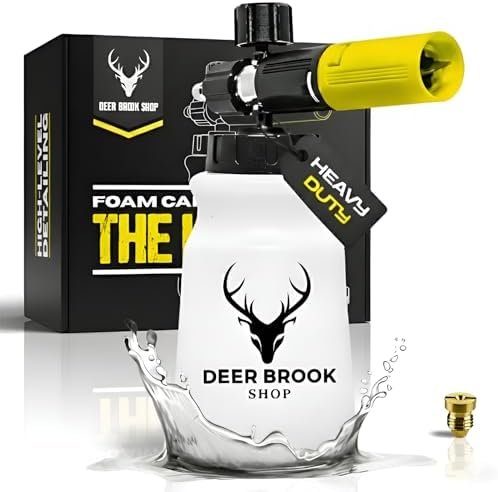
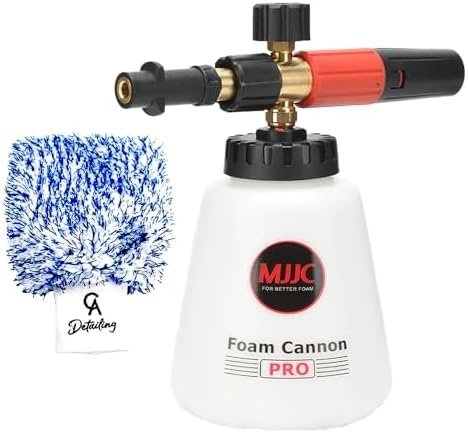
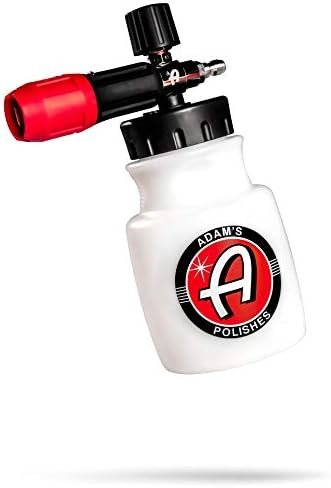
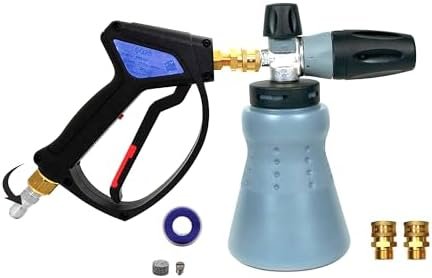
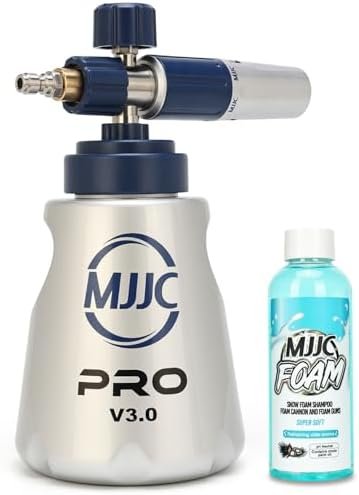
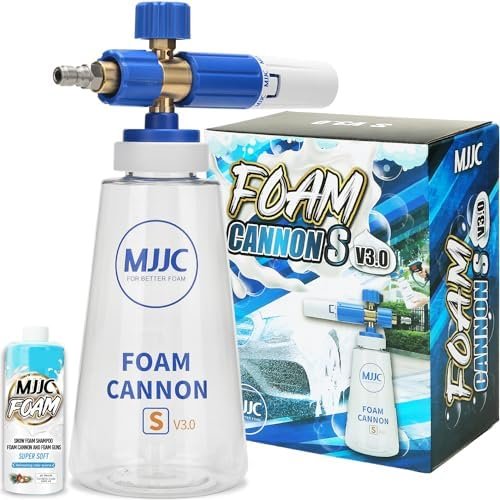
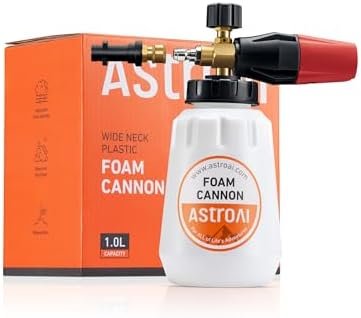
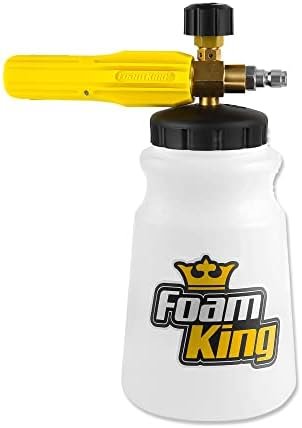
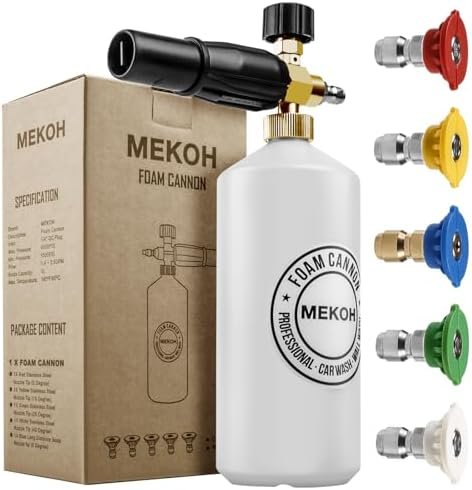
- Italian nickel-plated brass
- Patented two-stage nozzle
- 1,100–5,000 PSI range
- Stainless steel filter
| Product | Our Rating | Key Specs | ||
|---|---|---|---|---|
PF22.3
|
|
Check Latest Price | ||
PRO V3.0
|
|
Check Latest Price | ||
V2
|
|
Check Latest Price | ||
Big Mouth
|
|
Check Latest Price | ||
BOSS
|
|
Check Latest Price |
Foam cannons attach to your pressure washer and mix water, air, and pre-wash product to produce a thick, clinging foam layer across the entire vehicle. The foam stays on the surface long enough to break down road contamination before you touch the paintwork. The key is not the cannon itself, it is how the cannon, pressure washer, dilution ratio, and dwell time work together to produce the result.
Why your pressure washer, dilution ratio, and nozzle angle all affect the result
A foam cannon connects to your pressure washer lance and draws product from its bottle via a siphon tube. As water passes through at pressure, it mixes with the product and air to produce foam at the nozzle. The foam is then applied to the vehicle surface where it clings and dwells, allowing the chemical to work before any physical contact is made.
The quality of foam depends on several things working together, not just the cannon. Pressure washer output, product dilution ratio, nozzle angle, and fan width all affect how thick and clingy the foam is. A premium cannon on an underpowered washer produces thin foam. A basic cannon with the right dilution and adequate pressure often outperforms a premium unit used incorrectly.
Foam is a delivery method, not a cleaning upgrade on its own. The cannon gets the product onto the surface consistently and efficiently, more coverage, less product waste, no missed panels. The actual cleaning comes from the chemistry of the pre-wash product and the dwell time you allow before rinsing.
A foam cannon delivers product, the chemical does the cleaning
Matched to your pressure washer, session length, and frequency of use
Getting thick, clinging foam is about the interaction between these settings, not just the cannon
The amount of product relative to water in the bottle is the biggest single variable affecting foam thickness. Too dilute produces thin, watery coverage. Too concentrated wastes product without improving results. Always start with the manufacturer's recommended ratio and adjust from there.
Your pressure washer's output determines how much air and water passes through the cannon. Low pressure produces watery foam. High pressure (above 200 bar at close range) can over-aerate the mix, producing dry foam that doesn't cling. The 100-160 bar range is where most cannons perform best.
Adjustable nozzle fans on most cannons let you narrow the spray for panel edges or widen it for broad coverage. A 60-degree fan from 40-60cm is the most effective starting position for full-vehicle foam coverage. Narrowing the fan for speed misses gaps; widening it too much loses foam density.
Dwell time is when the chemistry actually works. Most pre-wash products need 3-5 minutes on the surface to break down road contamination before rinsing. Rinsing too soon wastes the application. Leaving foam until it dries reverses the process, dried foam can leave residue and reduce effectiveness.
Your washer's output is the single biggest factor in foam quality, get the right one for your setup
Compatibility with your pressure washer is the first and most important check
Identify your washer's lance connection type before buying any cannon. Most standard washers use M22 thread, but Karcher, Nilfisk, and some others use proprietary connections. Buying a cannon with the wrong fitting and adding an adapter reduces pressure at the joint. Getting the fitting right from the start removes the most common frustration with foam cannons.
Look for a cannon with both dilution and airflow adjustment. Being able to control these two settings independently gives you far more control over foam quality than fixed-setting models. A cannon that adjusts well covers more ground well regardless of which pre-wash product you are using.
Choose a wide-mouth bottle with at least 1.5 litre capacity. Wide-mouth design makes filling and cleaning much quicker. A 1-litre cannon runs short on SUVs and vans, you want to complete a full vehicle pass without interrupting the dwell sequence to refill.
Invest in a brass or stainless steel construction cannon rather than plastic. Plastic cannons degrade faster under repeated chemical exposure, particularly with alkaline pre-wash products. A quality metal cannon used weekly outlasts several cheaper plastic alternatives and maintains consistent foam output for longer.
If you already own a pressure washer, a foam cannon is the more effective option for pre-wash application, the foam is thicker, more consistent, and covers the vehicle faster. If you do not own a pressure washer, a foam pump sprayer or electric foam sprayer achieves a similar pre-wash result without the added equipment. See our guides for full comparisons of what each delivers without a washer.
The habits that produce thin foam, wasted product, and poor pre-wash results
Thick foam looks impressive but doesn't automatically mean better cleaning. Foam that clings and dwells is more useful than foam that looks dense but slides off immediately. Focus on dwell time and coverage consistency over visual thickness. The product does the work, not the foam itself.
Too dilute produces thin, patchy foam with limited dwell time. Too concentrated wastes product without improving results beyond a certain point. Always start with the manufacturer's recommended dilution and adjust based on results rather than defaulting to maximum product concentration.
Foam needs to stay wet to work. Once it dries, it can leave residue and the pre-wash benefit is largely lost. Work in sections on hot days or in direct sun, completing each area before moving on. A 3-5 minute dwell is sufficient, do not leave it longer hoping for better results.
Foam works best when loose surface dirt has already been removed. On a heavily soiled vehicle, a quick cold rinse with the pressure washer before applying foam loosens and removes bulk contamination, allowing the foam to work on the bonded grime that the rinse cannot shift. Skipping this step makes the cannon work harder for a lesser result.
Product residue left in the bottle, siphon tube, and nozzle dries out and clogs the cannon. After each use, empty the bottle, fill with clean water, run it through the system for 30 seconds, then disassemble and rinse. Five minutes of cleaning after each session prevents the most common cause of foam cannon failure and inconsistent output.
The rinse and wash steps that complete the pre-wash properly
Give the foam 3-5 minutes on the surface before rinsing. Rinsing immediately after application removes the product before it has had time to break down road contamination. Set a timer when you start and use the dwell time to prepare your contact wash equipment.
Rinse from the roof down, carrying loosened contamination off the vehicle rather than redistributing it. Cover the full surface including door sills, arches, and lower panels where pre-wash product tends to pool. A good pressure rinse after foam removes the majority of loose contamination before contact wash.
Pre-wash and foam removes what it can chemically, but a contact wash with a mitt and shampoo removes what remains physically. The foam stage reduces the contamination load and makes the contact wash safer and more effective, it is a preparation step, not a replacement for washing.
Click through to check today's price and availability from trusted retailers.
No. They help apply the pre-wash product evenly and increase dwell time, but the cleaning comes from the chemical itself. Foam improves the process, it doesn’t replace it.
Yes. Foam cannons are designed to work with pressure washers. If you don’t have one, you’ll need an electric foam or pump sprayer instead, but they won’t produce the same results.
Usually down to dilution or pressure. Too much water, not enough product, or a lower-powered pressure washer can all affect foam thickness. Adjust the mix and settings first before changing products.
Find the best UK detailing products across our range of categories.


Your independent guide to the best car detailing products in the UK.
Hundreds of car cleaning products, pulled from trusted UK retailers across every category - shampoos, sealants, interior, glass, tools and more.
Customer ratings, review volume, price-to-performance and editor testing notes feed the score. No brand payments, ever.
Total Car Clean is 100% reader-supported. We may earn a small commission from affiliate links, but we remain unbiased to help you find the best products.